Archives
- 2026-08-02: On How to Kill The Divine
- 2026-07-19: Danmaku, 1975, and a Thousand Doujin Dreams
- 2026-04-12: Cinema of Masaki Kobayashi: Humanism Under Siege
- 2026-04-05: Konbini & the Art of Ohitorisama
- 2026-03-29: Steel, Smoke, and Strategy: Weapons of the Sengoku Battlefield
- 2026-03-08: Layered Like Lace: How Harajuku Built a World of Its Own
- 2026-03-01: When You Know, You Know (Koi no Yokan)
- 2026-02-22: The Quiet Economy of Chance: Inside Japan's Gacha Culture
- 2026-02-18: The House Where the River Whispers
(And Why It Still Does) - 2026-02-15: Japanese Car Culture: Motorsport & Aesthetic Identity
- 2026-02-08: The Shinsengumi: Romanticised Orphans of the Shogunate’s Fall
- 2026-02-01: Kazuo Ishiguro’s "Never Let Me Go" : An Unprecedented Deep Dive into the Nature of Humanity
Wabi Sabi Weekly
2026-04-12 • Akira
Cinema of Masaki Kobayashi: Humanism Under Siege
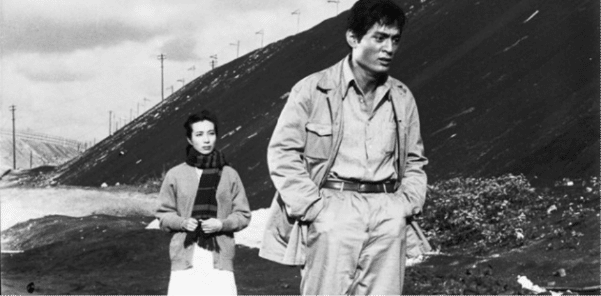
“It’s not my fault that I’m Japanese . . . yet it’s my worst crime that I am!”
Kaji, The Human Condition (1959–61)
Those were the words of the hero of The Human Condition trilogy, a 9.5-hour war time epic directed by the great Masaki Kobayashi. Those words carried anguish and existential despair, as a reflection of not only Kaji's struggle, but also that of Kobayashi’s.
Masaki Kobayashi, while still celebrated, is often overlooked in the talks of greatest film makers. Vintage Japanese cinema has become synonymous with the works of Akira Kurosawa—works like Seven Samurai and Yojimbo setting a standard for American Westerns to come, and works like Rashomon influencing the medium of storytelling, with its unreliable perspectives.
But while Kurosawa’s influence is unmatched, Kobayashi distinguishes himself in how deeply he engages with what I believe to be the most important aspect of storytelling:
The human heart.
Its characters and the depth they carry. The moral and emotional core of human existence.
To understand Kobayashi, you must know what led him down the path of film making, what brought forth this preoccupation with morality and inner conflict.
When Kobayashi graduated in 1941, with a degree in East Asian Art and Philosophy, he found himself confused about his path forward. Especially when finding himself with the possibility of being drafted into the army. A career in art history would’ve taken years of research, years he might not have. And this led him to studying a blooming new art form. Moving pictures, or as we know them as Films. In his own words, “With film, I thought there might be a chance of leaving something behind.”
He did lose years of his life due to the military draft. Years that would never return. And so, he aimed to say something in every film and every shot of it. Hence he engaged in social commentary in depth that many of his contemporaries shied away from.
One theme that he often revisited is that of authority.
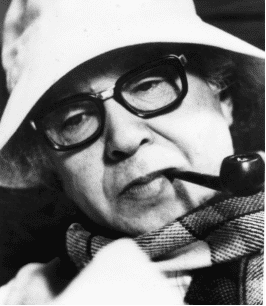
“All of my pictures . . . are concerned with resisting entrenched power. . . . I suppose I’ve always challenged authority. This has been true of my own life, including my life in the military." —Masaki Kobayashi
Nowhere does this personal philosophy manifest more clearly than in what many consider to be his best work—and one of the best films ever—
HARAKIRI
In Kobayashi's own words, Harakiri was his challenge to the cinema of Akira Kurosawa. Unlike many of the latter’s films which were about Samurai, Harakiri stood as the Anti Samurai movie.
It’s a film that does not indulge in any romanticisation, and though cruel it maybe, such is the reality. The film’s subtext was about the correction of history. He aimed to call out the lies about honour and the hypocrisy that was often overlooked, and glorified.
The idea Kobayashi was dismantling, was that of Bushido,
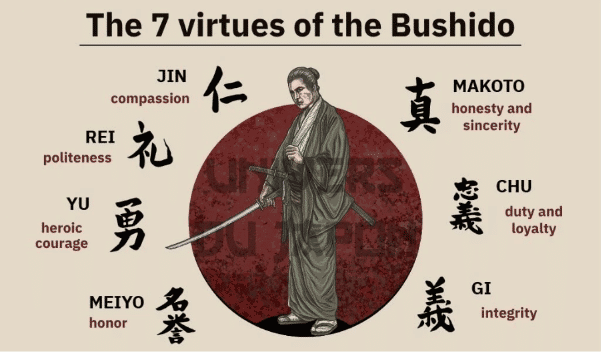
Samurai have existed in Japan for nearly a thousand years. While the concept of ‘Bushido’ existed, it is only natural that a uniform code does not stay for nearly a millenium. The reality was far looser, a flexible cultural ideal used when it was convenient for the Samurai.
The concept of Bushido as the Samurai’s honor bound moral code was a romanticisation where Samurais were equated to Western concept of Knighthood and chivalry.
The idea was originally popularized by a book written in the 1900s by one Inazo Nitobe. Bushido: The Soul of Japan in English, was a book written in English for a primarily Western audience.
Nitobe subverted the facts for an idealized reimagination of Japan's culture and past, infusing Samurai with Christian values so as to influence the Western perception of them. As he tamed the perception of the samurai, Nitobe even tried to justify some of their most savage customs– seppuku (the titular Harakiri) – using Christian morality.
Nitobe declared that in both Western and Japanese custom, the soul is housed in the stomach. *"*They (The Bible's Joseph, David, Isaiah and Jeremiah) all and each endorsed the belief prevalent among the Japanese that in the abdomen was enshrined the soul.” And added to it, “The highest estimate placed upon honour was ample excuse with many for taking one's own life," before challenging Western readers to resist his interpretation, "I dare say that many good Christians, if only they are honest enough, will confess the fascination of, if not positive admiration for, the sublime composure with which Cato, Brutus, Petronius, and a host of other ancient worthies terminated their own earthly existence."
And this clever manipulation worked.
Even though this idea was originally rejected in Japan and seen as glorification of an exploitative system that everyone but Samurai wanted to be left as history, Nitobe's ideology would be embraced by the Japanese government and the extreme nationalist movements that began to take shape. The government used this concept of ‘Soul of Japan’ and created a nostalgia among the civilians for a history that was never true. It helped to pave the way for Japan’s eventual rise into Fascism.
Even as recently as 1970, just 8 years after the release of Harakiri, the legendary author Yukio Mishima, after a failed coup, committed seppuku under the name of the Bushido code.
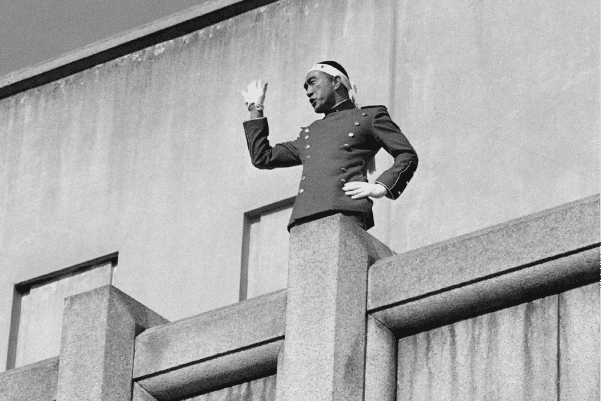
Yukio Mishima’s failed coup attempt
All of this adds context to the boldness of Masaki Kobayashi and the making of Harakiri. He was called Anti-Japanese, yet as he always did, Kobayashi wanted to communicate his beliefs above all else.
Another contrast I draw with Akira Kurosawa is the depiction of violence. Kurosawa’s fight scenes are flashy, where characters slash and cut through enemies at lightning speeds. This is by no means a criticism—Kurosawa’s amazing fight scenes set a standard for Hollywood and many movies to come. But where I think Kobayashi’s brilliance shines is the weight. Weight of not only the blows, but of human life. You can feel the sword cut into the flesh, and the pain echoing from it.
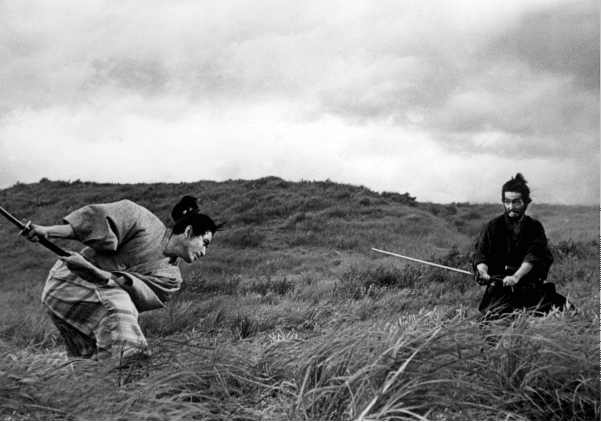
Tsugumo Hanshiro faces Hikokuro Omodaka
I see this as Kobayashi’s reaffirmation of the individual. Or perhaps a prayer that we aren’t another replaceable life. And the scene that encapsulates this is the final sequence.
Tatsuya Nakadai(A name you are going to hear again) stands as one of the greatest actors ever, delivering a devastating performance as Hanshiro Tsugumo. What makes his portrayal extraordinary was the restraint—the way grief, rage, and humiliation were held just beneath the surface, feelings you see as you go further into the movie. (Scroll to next section to avoid spoilers)
All he aimed to do is get an apology, to make the system acknowledge its flaw. It's his struggle to reach this goal. That is the brilliance of Kobayashi’s films. The villain is a monolithic entity. Its parts are replaceable, and it's not always one rotten apple that ruins the basket. How do you fight against such a thing?
Hanshiro’s last stand against the Iyi clan is made all the more devastating with that realization. It was almost as if Kobayashi himself were flailing against the injustice in it all.
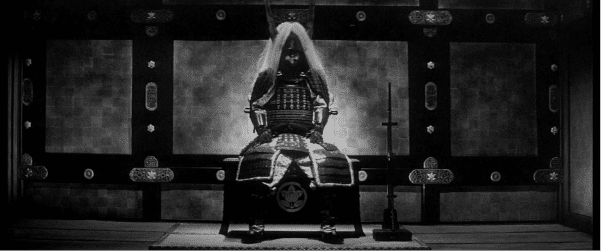
The Symbolic Personification of the Bushido code
If Harakiri is Kobayashi’s most explicit attack on institutional myth, his next film descended into something more abstract;
KWAIDAN
Kwaidan is, visually, the boldest movie I have seen.

And dare I say visually my favourite
Kwaidan (Pronounced Kai-dan) is a word that roughly translates to ghost stories, or rather the older Japanese ghost stories. An adaptation of Lafcadio Hearn’s book of the same name, it is an anthology of 4 older Japanese horror stories.
There is perhaps never going to be another movie like Kwaidan. It's a film made in giant constructed sets—They rented out an old WW2 Aeroplane hangar to store a few of them—and Kobayashi, to get the best idea of his own vision, hand painted some of the sets.
I felt confident in claiming there might not be another movie such as this for a simple reason: In the modern landscape of movies, you do not see movies shot as such, and not to mention it's rare thing to see such an obsession towards craft.

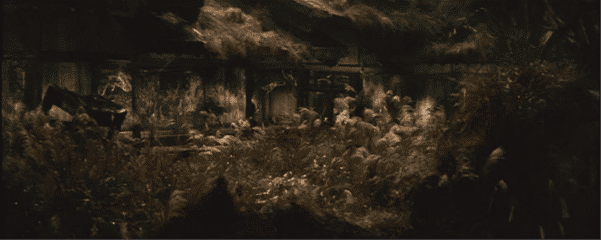
The shots in this movie are unreal (Quite literally)
The movie brilliantly handles a juxtaposition. The sets are so clearly fake, that it feels like a live performance—not something recorded. You truly feel it when the ghosts begin to enter the story. The sets shift, the otherworldliness enters the screen. Previously static camera angles now move as if possessed by the ghost. This is where the fakeness of the world serves its purpose, as you find the characters entering a world descending into uncanniness
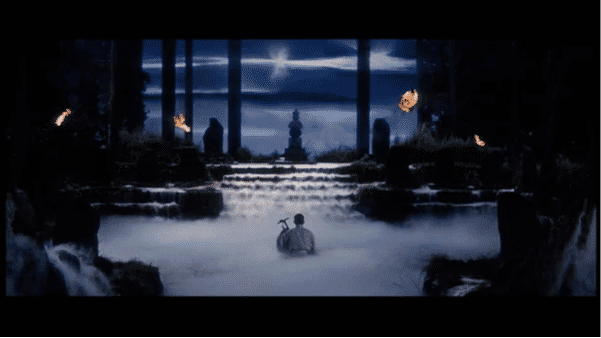

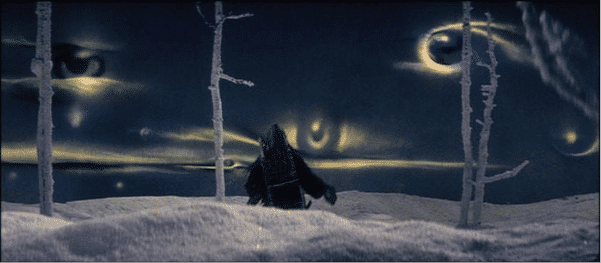
If there is one thing I am hoping to convince you of, that’s to watch Kwaidan.
Its brilliant
But why did Kobayashi make this movie, after the hit of Harakiri—a film that is nothing like this?
Yet I digress. Even this is a movie that carries a spirit not too dissimilar.
Kwaidan is a horror story less concerned with fear in the conventional sense, and more with consequence, with justice. In its stories ghosts are the consequence, where the past is never truly past and always returns to haunt them. Memory has weight and choices endure in it.
This is another place where the brilliance of background sets shines. It is not a world of humans invaded by ghosts. It is a world that was always supernatural, where we only exist alongside them. And by that, it is a world of consequences.
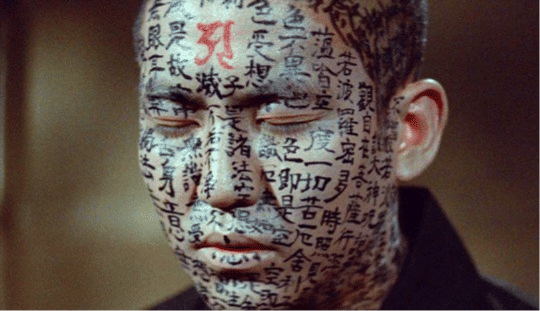
Hoichi the Earless—My favourite of the 4 stories
Was it perhaps justice that Kobayashi desired?
JUSTICE
Many of you might have heard of Unit 731, a horrific division of the Japanese military.
Their focus was on development and research of biological warfare, not shying away even from human experimentation. Their crimes were the worst of humanity; Live vivisections of Chinese prisoners, weaponizing plague, infecting communities and more.
I bring this up because the head surgeon of this division, Shiro Ishii, was released, on American authority, using the value of his own research as a shield.
He lived a full life, with two kids, and died of cancer at age 67.
Kobayashi was a man frustrated by the unfairness in the world. It was covered in another one of his movies, ‘The Thick-Walled Room’, where lower ranked soldiers were the ones punished for their crimes, yet the higher ranked get away.
Responsibility for action was something Kobayashi greatly valued. And one thing he wanted to hold to a trial was his own nation, and its crimes throughout WW2.
That brings us to what I believe to be among the greatest works of cinema—
THE HUMAN CONDITION TRILOGY
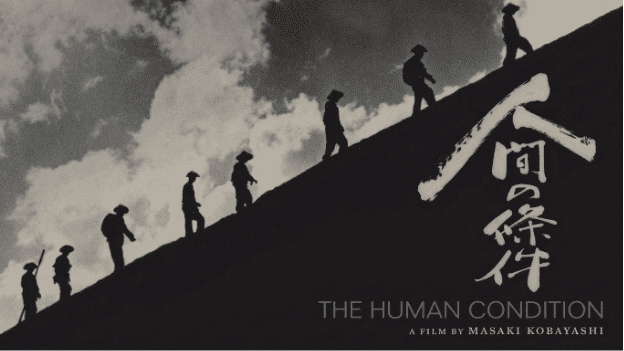
I hold this near 10-hour mammoth of a trilogy to be Masaki Kobayashi’s magnum opus. It is a humanist tale lamenting the loss of humanity, an antiwar movie that shows the system enabling the greatest tragedies in human history in a naked light.
The film was based on both Junpei Gomikawa’s 6 volume novel, and Kobayashi’s own experiences.
The protagonist Kaji—who was portrayed again, by the incredible range of Tatsuya Nakadai—was much like Kobayashi himself. A pacifist and a left-wing humanist idealist. And they both faced the inevitability of a military draft.
So, when his boss offers him a job as head of personnel at the company’s mining camp in Manchuria, Kaji accepts it—even though he knows it involves supervising forced Chinese labor—since it grants him exemption from military service.
This was the first—and far from the last—dilemma Kaji faces. He had to accept a role in this oppressive system, to avoid a worse fate for himself, that is, engaging in the atrocities of war he condemned. Despite the moral compromise, Kaji believed in his ability to better the conditions of the Chinese prisoners of war. There is a sense of selfishness and self-righteous fervour in that belief that the film never shies away from. When he arrives at the mine, his naivety and arrogance is displayed, as he disparages his colleagues, only to invite their ire.
When confronting the cynical boss of the mine, Kaji asks him to treat the Prisoners of War ‘as men’. He receives a dismissive reply, “What is a man? He’s a mass of lust and greed that absorbs and excretes.”
The cruelty of the argument is clear, yet it’s not easy to refute. If the world was made with people as its replaceable blocks, how was one man supposed to affect it with belief alone? And this question is pushed over and over at both Kaji and the audience.
Wang, one of the leaders among the prisoners, with whom Kaji tries to establish a rapport, says, “You have less faith in men than you try to believe.”
The true challenge in holding firm lies in finding kindred spirits. To his compatriots, Kaji ends up as an ‘enemy sympathizer’ and ‘a Red’ (ie, Communist). To the Chinese, he’s a member of their oppressor’s race, a ‘Japanese Devil’, and as one of the Chinese prisoners claims, ‘has face of a man, but the heart of a beast.’
Throughout the Trilogy, the pattern repeats. Vulnerable characters he tries to protect, end up hurt nevertheless.
This near 10-hour film is an exhausting piece of cinema—not just for its length, but for its harshness. It grinds the protagonists physically and mentally. And for viewers, the pressure comes from one fact: The film is honest about history.
It disdains spectacles of individual triumph that would be emotionally satisfying for viewers but would tend to falsify the existential situation faced by a conscript soldier like Kaji, who has been ingested by a machine that is much bigger than he.
Yet, it's not nihilistic.
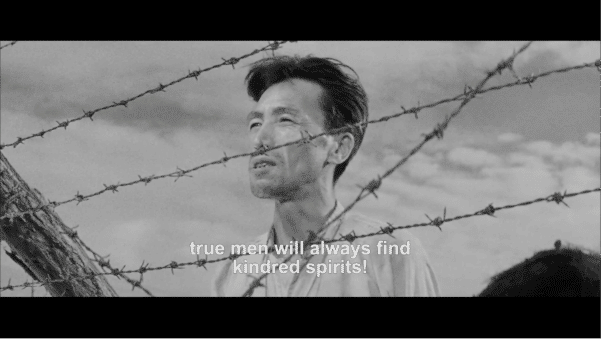
The scene where Wang asks Kaji not to lose trust in humans, for a True Human can always find kindred spirits regardless of circumstances
There is good in the world, only it is in a system that does not allow it to show itself. The Second movie brought that to the forefront.
Kobayashi made the second movie, “The Road to Eternity” into an excoriation of the Imperial Army. And a direct reflection of his own life in the military.
In his Miyakojima diary, Kobayashi wrote, “I want to curse this military life.” He wrote that the place was swarming with officers who were lower than soldiers. “We are humiliated daily by the officers.” As a result, he noted, “I haven’t come across many of the sort of people whom I feel I could die alongside.” He described how officers would “use soldiers thoughtlessly, while they themselves make no effort to hold even a small shovel.” This wasn’t a criticism of the higher officials alone however. As the character of Kaji himself notes at the idea of fighting the unfairness with court and legality, “We’d be sure to lose. We can’t win. Maybe we could give those vets a good licking but they’re not the real enemy. Our real enemy is the army.”
The brilliance of Kobayashi’s characters is that they are simultaneously the oppressed, yet in the act of participating in the system enabling the oppression, they also become the oppressors.
As one Japanese Historian, Ienaga Saburo wrote, “It provided an outlet for pressure by allowing each rank to shift the oppression to the one below. The operation snowballed as it rolled down the ranks, till all the tensions and abuse landed on the recruits.” As a result, “men under constant pressure would explode in irrational, destructive behaviour. Individuals whose own dignity and manhood had been so cruelly violated would hardly refrain from doing the same to defenceless persons under their control.”
The focus of “The Road to Eternity” is sociological in that it observes and condemns the behavior of an institution that, in its turn, left behind a horrific legacy. It's a descent into ruthlessness and barbarity during the 1930s whose repercussions are still felt today through much of Asia. Though not as popular as their German counterparts’, the actions of Fascist Japan are arguably just as bad.
Which is the true horror of Kobayashi’s films to me. Perpetrators of this horror were simultaneously victims. And considering the hate Kobayashi himself faced at his ‘anti-National’ values, one must wonder, could they have resisted this system? Could you have been convinced to treat another human as a lesser life in another world? People were convinced back then. People still are convinced of such things.
A Soldier’s Prayer
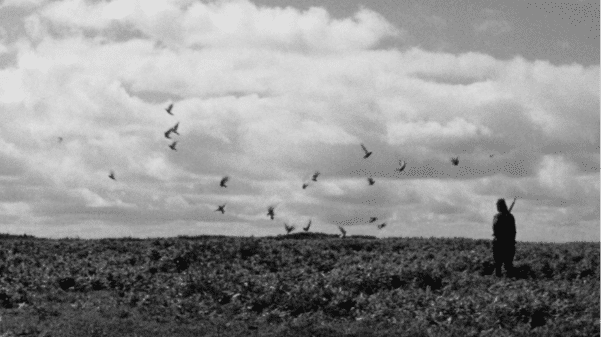
The third film, “A Soldier’s Prayer” presents a drastic shift. It is no longer Kaji desperately flailing to bring a change—it is a story about the desire to survive. Kaji recognizes that desire, and proclaims that he is willing to become a ‘monster’ if it means to survive.
We see the change in our formerly pacifist protagonist in the very first scene of the movie, where he murders a Soviet Sentry. The narrative, therefore, raises questions about the extent to which the higher values that he has aspired to grasp have survived his experiences in the war. Could his ideal coexist with the adaptation he has made? He believes in the sanctity of life and yet he has become a killer of men.
The movie in essence is a long walk from Northern Manchuria by the Soviet border, to the South to meet his wife. It is hence the most human. If “The Road to Eternity” has an almost sociological focus, studying the brutal practices of the Kwantung Army and Kaji’s responses to these, “A Soldier’s Prayer” turns inward. It is the most poetic film in the trilogy, as at the end of the journey, Kobayashi abandons any grand idea for change and instead shifts focus to the ruminations and memories of Kaji and other characters. Each have a different reason to reach home, and that is all they could think of. To Kaji it was his wife, who began to become a symbol of forgiveness in his mind—forgiveness for losing his ideals.
While in retrospect, we are aware of the great human cost of the Soviet Regime, specifically Stalinist Russia, to Masaki Kobayashi, and by extension Kaji (who was also Socialist), Russia offered an alternative to the Japanese Fascism and the degraded moral landscape. The appeal of Communism is the pursuit of the greater good—something we see Kaji attempt from the beginning.
But Kaji sees first hand, the state of Japanese settlements in Manchuria taken over by the Soviet troops, and the crimes committed by the latter. When Kaji talks of it to a fellow Red sympathizer, Tange, he gets the reply, “A flaw of the transition period that will surely be corrected.” For Tange, rape and pillaging by Soviet soldiers is a temporary phase in the unfolding of historical laws whose ultimate outcome is beneficent, and thus such transgressions are acceptable, albeit regrettable. As Tange voices his conviction about the logic of history, the camera moves into a tight close-up of Kaji, who feels that attempts to ideologically recoup and redeem acts of savagery are wrong.
And so, goes the logic often used to justify revolutionary violence—not necessarily inherent to Communism itself, but to the way it has been interpreted and enacted in practice. Communist states have often come through revolution leaving a great number of casualties. The transition period is often no better. An extreme example is the Holodomor, which resulted in millions of deaths. While not always openly justified, such suffering was often subsumed under the broader goal of rapid industrial and ideological transformation.
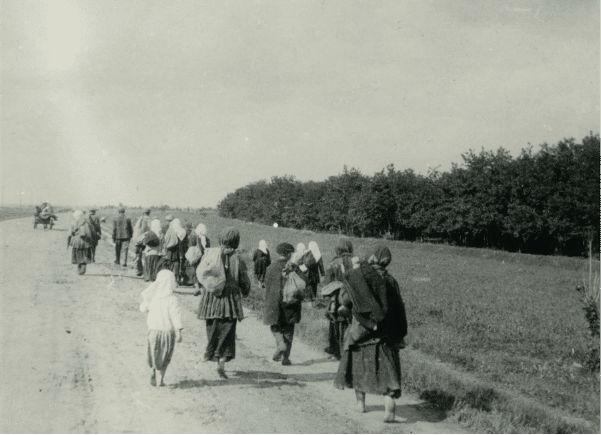
Holodomor: One of the greatest tragedies in Human history
It is in the end Humans who suffer. It is the human condition being tested to its utmost.
Conclusion
The most haunting of ideas across his entire filmography that Kobayashi conveys, is that everyone is human. It is the regular humans like you and me that are convinced into depravity. The characters are often complex enough for us to hesitate in blaming them for losing their firmness of belief. They ask us how far from your comfort zone would you yourself be capable of going.

"Personally, I am not pessimistic, although it is very easy to become so after examining the history of humanity. [Harakiri] ends as a tragedy. But my underlying theme transcends that. I try to express the possibility that human beings can overcome the tragic events of the world."
Kobayashi’s films make you confront every selfish aspect of the human soul. Yet all of them have a clear beauty, a heart. They carry the desire to live, to bring justice in the world, and willingness to keep fighting even when every single thing in the world is against you.
The movies do not communicate pessimism; they communicate the creator’s frustrations. Frustrations of an idealist, watching as the society and world he lived and loved went in the wrong direction.
And perhaps that is what makes Kobayashi’s films stand the test of time. The ideas that lead him to make the films he did are ones everyone felt at some point: Unfairness, Manipulation of truth, and the loss of Individuality. They feel especially relevant now, in a world where it is increasingly easy to be conformed into groups—where social media, political divides, and collective identities shape what we see and believe—the individual conscience risks being diluted, if not entirely lost. The systems may look different now, less overt, less violent, but the pressure to conform, to accept ready-made truths, remains just as persistent. Never before has confirmation bias been so wide spread as it is now.
Kobayashi’s films, then, act as almost a wake-up call. They remind us of the importance in the often uncomfortable pursuit of truth. That to think, to question, and to resist—even in small, seemingly futile ways—is perhaps the only way to preserve one’s humanity.
To survive the siege against one’s humanity.
And in that sense, his message feels less like a relic of history, and more like something we are still being asked to confront.
A Remembrance of Tatsuya Nakadai
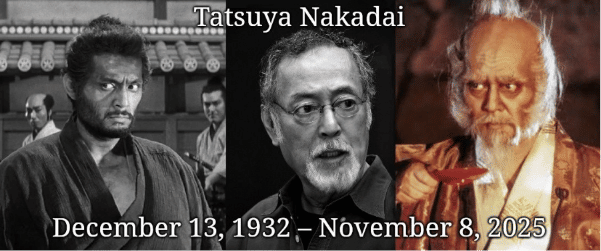
Rest in Peace
One of the greatest actors ever
Most renown movies: The Human Condition(1959, 1961), Yojimbo(1961), Harakiri (1962), Kwaidan (1964), Samurai Rebellion (1967), and Ran (1985)
His final role was in 2020 at the age of 88